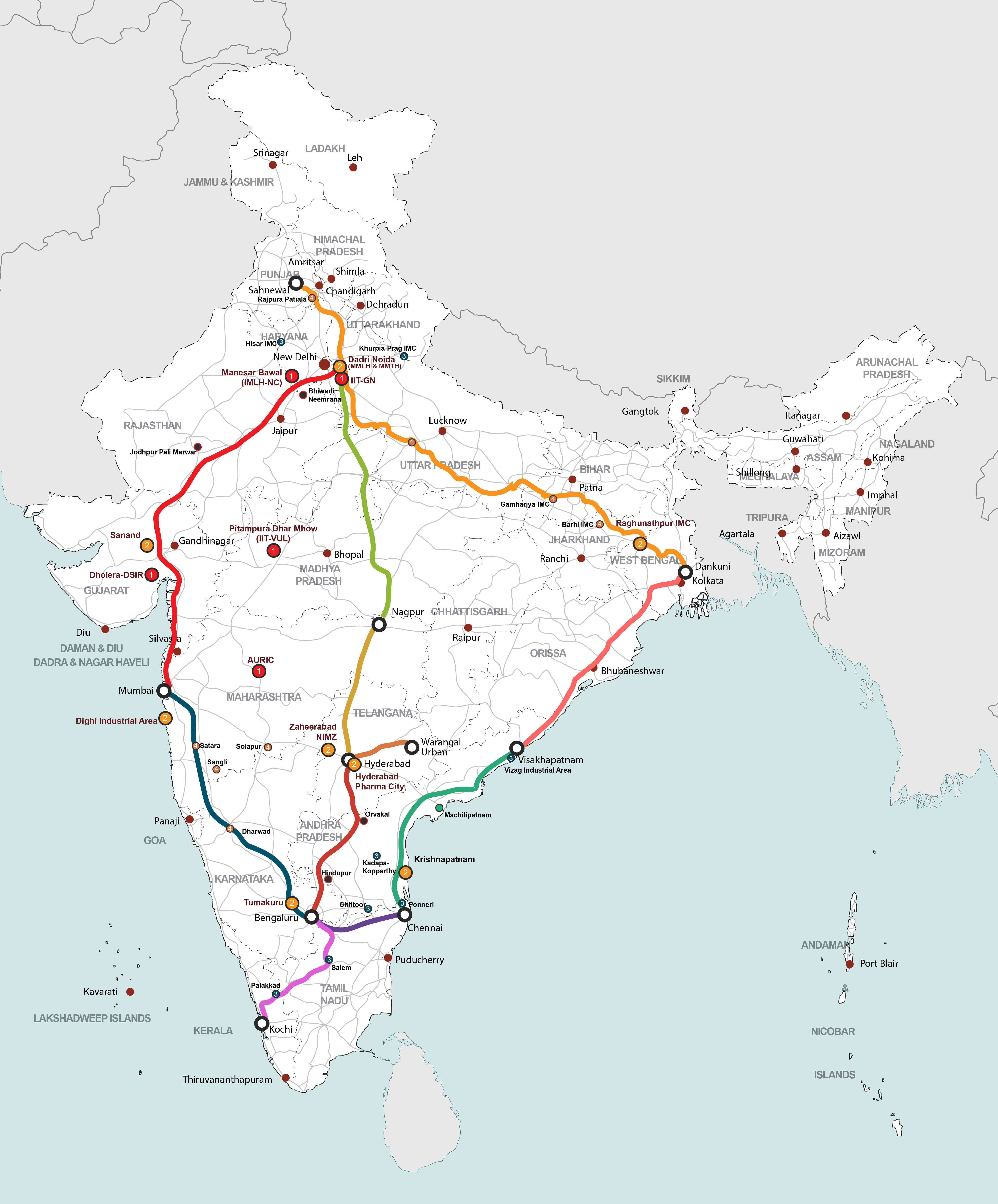
The Delhi-Mumbai Industrial Corridor (DMIC) is one of India's most ambitious infrastructure projects, strategically designed to enhance industrial development by connecting the nation's political capital, Delhi, with its financial powerhouse, Mumbai. Spanning an impressive 1,504 kilometers, the corridor aims to create a high-speed transportation network, integrating industrial zones, logistics hubs, and smart cities along its route. This mega project seeks to transform India into a global manufacturing and investment destination by offering world-class infrastructure and seamless connectivity.
With an estimated investment of USD 90 billion, the DMIC is being developed through a partnership between the Government of India and Japan. Funding sources include Japanese loans, investments by Japanese firms, and capital raised through Japan Depository Receipts issued by Indian companies. This international collaboration not only brings financial support but also incorporates advanced technology and best practices in industrial development.
The project is spearheaded by the National Industrial Corridor Development Corporation (NICDC) Limited, formerly known as the Delhi Mumbai Industrial Corridor Development Corporation (DMIDC) Limited. NICDC, a joint venture with 49% equity held by the Government of India, 26% by the Japan Bank for International Cooperation (JBIC), and the remaining by Indian government financial institutions, plays a pivotal role in planning, promoting, and facilitating the corridor's development. The corporation works closely with central and state governments to establish industrial regions, economic zones, and smart townships along the corridor.
Several key industrial areas have been identified for development, ensuring balanced regional growth. The three major industrial areas under DMIC are:
- Shendra-Bidkin Industrial Area (SBIA) in Maharashtra
- Dighi Port Industrial Area in Maharashtra
- Jodhpur-Pali-Marwar Industrial Area (JPMIA) in Rajasthan
The DMIC project is progressing steadily, with trunk infrastructure nearing completion at strategic locations in Gujarat, Maharashtra, Uttar Pradesh, and Madhya Pradesh. These sites are poised to become major industrial hubs, fostering economic activity and generating employment opportunities.
Key projects under the DMIC umbrella include:
- Dholera Special Investment Region (DSIR), Gujarat: Spanning 22.5 sq. km (5,560 acres)
- Shendra-Bidkin Industrial Area (SBIA), Maharashtra: Covering 18.55 sq. km (4,583 acres)
- Integrated Industrial Township – Greater Noida (IITGN), Uttar Pradesh: 747.5 acres
- Integrated Industrial Township – Vikram Udyogpuri (IITVU), Madhya Pradesh: 1,100 acres
- Integrated Multi-Modal Logistics Hub, Nangal Chaudhary, Haryana: 886 acres
- Multi-Modal Logistics Hub (MMLH) and Multi-Modal Transport Hub (MMTH), Uttar Pradesh: 1,184 acres
- Dighi Port Industrial Area, Maharashtra: 6,056 acres
- Jodhpur-Pali-Marwar Industrial Area (JPMIA), Rajasthan: 6,570 acres
- Khushkhera-Bhiwadi-Neemrana Industrial Area, Rajasthan: 1,378 acres
- Mandal-Becharaji Special Investment Region (MBSIR), Gujarat: 2,849 acres
The Delhi-Mumbai Industrial Corridor represents a transformative leap forward for India's industrial landscape. By fostering investment, enhancing infrastructure, and promoting planned urbanization, the DMIC is set to position India as a global leader in manufacturing and trade, driving long-term economic growth and regional development.
 - Yathin.jpg)
The Chennai-Bengaluru Industrial Corridor (CBIC) is a transformative infrastructure project designed to drive accelerated economic growth and foster industrial development across three key southern states of India — Tamil Nadu, Karnataka, and Andhra Pradesh. This strategic corridor aims to strengthen regional industry clusters by offering seamless connectivity to production hubs, lowering transportation costs, and enhancing supply chain efficiency. By reducing logistics costs and improving delivery timelines, the CBIC is set to attract significant private investments in manufacturing and industrial activities, boosting the region's economic landscape.
The Japan International Cooperation Agency (JICA) played a crucial role in shaping the CBIC by conducting a preliminary study for a Comprehensive Integrated Master Plan. The study identified 25 priority projects aimed at eliminating infrastructural bottlenecks and ensuring the corridor’s smooth implementation.
Key Nodes of CBIC
The CBIC focuses on the development of three major industrial nodes, each strategically selected to drive regional economic growth:
-
Krishnapatnam Industrial Area, Andhra Pradesh
Spread across 11,098 acres, the Krishnapatnam node will be developed in three phases, leveraging its proximity to the Krishnapatnam port for enhanced trade and industrial activity. -
Tumakuru Industrial Area, Karnataka
Covering 8,484 acres, the Tumakuru node is also planned in three phases. Notably, work on Phase-A (Activation Area), spanning 1,722 acres, is already underway, with the foundation stone laid by the Hon’ble Prime Minister on February 6, 2023. -
Ponneri Industrial Area, Tamil Nadu
Spanning 4,000 acres, the Ponneri node is currently in the planning phase, with a consultant appointed to prepare a Detailed Master Plan and carry out Preliminary Engineering work.
Current Project Status
The Perspective Plan for the CBIC has been completed, providing a roadmap for future development. With ground-level work already initiated and key nodes identified, the CBIC is poised to become a critical driver of industrial growth in southern India. This corridor not only aims to boost manufacturing but also fosters regional economic integration, paving the way for new job opportunities and sustainable development.
 - Yathin.jpg)
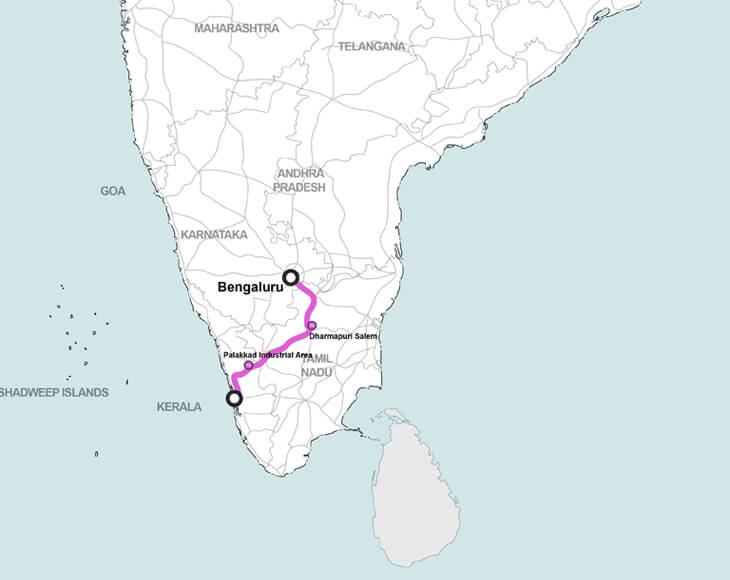
The Chennai-Bengaluru Industrial Corridor (CBIC) is expanding its reach with an extension to Kochi via Coimbatore — a significant move approved by the National Industrial Corridor Development and Implementation Trust (NICDIT). This expansion aims to strengthen industrial connectivity across Kerala and Tamil Nadu, enhancing economic growth and unlocking new investment opportunities.
The extension focuses on developing two key industrial nodes:
-
Palakkad, Kerala
Strategically positioned to leverage Kerala's trade potential, Palakkad is set to become a hub for industrial and logistics activities. -
Dharmapuri, Tamil Nadu
With its proximity to major transport routes, Dharmapuri offers a prime location for industries seeking efficient access to both domestic and international markets.
Current Status of the CBIC Extension
The project is gaining momentum with critical groundwork already underway:
- Detailed Master Planning and Preliminary Engineering have begun for the Palakkad and Salem nodes, ensuring a well-structured industrial infrastructure.
- The Shareholder’s Agreement (SHA) and State Support Agreement (SSA) are in the process of being finalized, paving the way for coordinated development efforts between the central and state governments.
By expanding the CBIC to Kochi, the project aims to boost industrial competitiveness, create jobs, and foster regional economic integration across Kerala, Tamil Nadu, and Karnataka. This extension strengthens India's industrial network, encouraging private investments and supporting the government's "Make in India" initiative.
Source: 1
The Amritsar-Kolkata Industrial Corridor (AKIC) is a transformative mega infrastructure project designed to boost industrial growth across seven states in northern and eastern India. Stretching 1,839 km from Amritsar in Punjab to Dankuni in West Bengal, the corridor passes through Punjab, Haryana, Uttar Pradesh, Uttarakhand, Bihar, Jharkhand, and West Bengal. Additionally, the Baddi-Barotiwala-Nalagarh (BBN) industrial belt in Himachal Pradesh—located just 70 km from the Eastern Dedicated Freight Corridor (EDFC)—has been included in the AKIC influence zone, reinforcing regional connectivity.
Key Industrial Nodes
The AKIC focuses on developing Integrated Manufacturing Clusters (IMCs) to attract investments and enhance industrial competitiveness. The following IMCs have been identified for phased development:
- Hisar IMC, Haryana (2,988 acres)
- Prag-Khurpia Integrated Manufacturing Cluster, Uttarakhand (1,002 acres)
- Rajpura-Patiala IMC, Punjab (1,100 acres)
- IMC at Agra, Uttar Pradesh (1,059 acres) & Saraswati Hi-Tech City, Prayagraj (1,141 acres)
- New Barhi Node, Jharkhand
- IMC at Gaya, Bihar (1,600 acres)
Current Project Status
Significant progress has been made in planning and development:
- The Perspective Plan for AKIC has been completed.
- Raghunathpur IMC, West Bengal — 2,483 acres of land identified, with detailed master planning and preliminary engineering completed.
- Prag-Khurpia farms, Uttarakhand — 2,935 acres of land identified, with the Shareholder's Agreement (SHA) and State Support Agreement (SSA) in the finalization stage.
- Hisar, Haryana — Plans are underway to initiate the detailed master planning and preliminary engineering process.
Driving Economic Growth
The AKIC is poised to reduce logistic costs, enhance supply chain efficiency, and create a robust industrial ecosystem across northern and eastern India. By strengthening regional infrastructure and streamlining industrial processes, the corridor aims to attract private investments, generate employment opportunities, and support the Indian government's "Make in India" initiative.
 - Yathin.jpg)
The Hyderabad-Nagpur Industrial Corridor (HNIC) is a vital infrastructure project aimed at accelerating industrial development across Telangana and Maharashtra. With robust connectivity via rail, road, and airways, the corridor plays a strategic role in strengthening industrial growth, fostering investment, and enhancing regional economic activity.
Key Industrial Node: Zaheerabad
A cornerstone of the HNIC is the Zaheerabad Node in Telangana, spanning an impressive 12,635.14 acres across 17 villages in the Nyalkal and Jharasangam Mandals of Sangareddy District. Strategically located:
- 9 km north of Zaheerabad — a major commercial hub.
- 80 km northwest of Hyderabad — Telangana's state capital.
- 65 km from Hyderabad Outer Ring Road (ORR) — ensuring seamless intra-state connectivity.
- 48 km from the proposed Regional Ring Road — further boosting accessibility.
The first phase of Zaheerabad Node is set to develop 3,909 acres, focusing on creating an industrial ecosystem that attracts manufacturers, facilitates logistics, and fosters innovation.
Driving Industrial Growth
The HNIC aims to:
- Reduce transportation costs by leveraging multi-modal connectivity.
- Boost manufacturing competitiveness by streamlining supply chains.
- Attract private investment to build world-class industrial infrastructure.
By linking key urban centers and industrial hubs, the corridor is poised to transform the economic landscape of Telangana and Maharashtra, supporting the Make in India initiative and generating employment opportunities.
 - Yathin.jpg)
The Hyderabad-Warangal Industrial Corridor (HWIC) is a transformative infrastructure project spanning 235 km along NH 163, connecting Hyderabad and Warangal—two key economic hubs in Telangana. This corridor aims to eliminate infrastructure bottlenecks and harness the region's industrial potential, creating a thriving ecosystem for businesses and investors alike.
Strategic Industrial Nodes
The HWIC is designed around 11 high-impact, market-driven nodes strategically located along the corridor. These nodes are envisioned as self-sustaining industrial hubs equipped with:
- World-class infrastructure to support industrial growth.
- Seamless road and rail connectivity for efficient freight movement to ports and logistics centers.
- Reliable power supply ensuring uninterrupted operations.
- Modern social infrastructure to enhance the quality of life for workers and residents.
This integrated approach aims to attract both domestic and international investors by offering a transparent, business-friendly environment.
Hyderabad Pharma City: A Priority Node
A key highlight of the corridor is the Hyderabad Pharma City—recognized as a Project of National Significance and part of the National Investment and Manufacturing Zone (NIMZ).
The first phase of the Hyderabad node will span 8,000 acres, focusing on developing a cutting-edge pharmaceutical and life sciences hub. This initiative not only strengthens Telangana’s position as the Pharma Capital of India but also paves the way for innovation-driven industrial growth.
Unlocking Economic Potential
The HWIC is poised to:
- Boost regional development by linking industrial zones with major cities.
- Attract private investment by offering robust infrastructure and government support.
- Generate employment across various sectors, fostering inclusive economic growth.
With its strategic location, integrated infrastructure, and business-centric approach, the Hyderabad-Warangal Industrial Corridor stands as a cornerstone of Telangana’s industrial future, supporting the Make in India initiative and driving long-term economic progress.
 - Yathin.jpg)
The Hyderabad-Bengaluru Industrial Corridor (HBIC) is a strategic infrastructure project designed to boost industrial connectivity across Telangana, Andhra Pradesh, and Karnataka. This corridor aims to link the central regions of India with the southern states, enhancing economic integration and fostering industrial growth along its route.
As an extension of the Hyderabad-Nagpur Industrial Corridor (HNIC), the HBIC focuses on creating an efficient industrial network by improving transport logistics, reducing supply chain bottlenecks, and encouraging private sector investments in manufacturing and industrial sectors.
Orvakal Node: The Mega Industrial Hub
A key highlight of the corridor is the Orvakal Mega Industrial Hub in Kurnool district, Andhra Pradesh. Spanning approximately 4,742 acres, the hub is strategically positioned along NH 40, a critical highway that connects Hyderabad to Chennai via Kurnool, Nandyal, Kadapa, and Tirupati. This prime location ensures seamless road connectivity, boosting trade and industrial activity in the region.
In the first phase of development, the following steps have been undertaken:
- Detailed Master Planning and Preliminary Engineering: Expert consultants have been appointed to map out a sustainable and efficient industrial layout.
- Site Survey and Technical Assessments: Thorough land suitability studies, base mapping, and infrastructure assessments have been completed.
- Preliminary Master Plan: A draft plan has been prepared, outlining land usage, transport networks, and essential utilities.
Driving Regional Economic Growth
The Hyderabad-Bengaluru Industrial Corridor is set to:
- Strengthen industrial ties between central and southern India.
- Attract investment by offering world-class infrastructure and business-friendly policies.
- Generate employment and support the growth of industries such as manufacturing, logistics, and technology.
By bridging industrial zones with major cities and creating a robust supply chain ecosystem, the HBIC promises to be a game-changer for the region’s economic landscape.
 - Yathin.jpg)
The Bengaluru-Mumbai Industrial Corridor (BMIC) is a transformative infrastructure project aimed at developing a resource-efficient industrial base supported by world-class connectivity. Stretching across the states of Karnataka and Maharashtra, the corridor is set to unlock new avenues for innovation, manufacturing, job creation, and economic growth.
Key Nodes Driving Industrial Growth
Two major industrial nodes have been identified for development under the BMIC:
- Dharwad Node, Karnataka: Spanning approximately 6,042 acres, Dharwad has been prioritized for early implementation. Known for its strategic location, the node will benefit from seamless transport networks, attracting industries in manufacturing, technology, and logistics.
- Satara Node, Maharashtra: Covering around 12,355 acres, the Satara node is poised to become a manufacturing powerhouse. The Maharashtra government has also granted in-principle approval for the development of the Sangli/Solapur node, further expanding the corridor’s influence in the state.
Current Progress and Development
- Both Karnataka and Maharashtra governments have confirmed land availability for the Dharwad and Satara nodes.
- Expert consultants have been appointed to conduct Detailed Master Planning and Preliminary Engineering for both nodes.
- With Dharwad identified as the priority node, work is progressing rapidly, setting the stage for future investments and industrial activity.
A Boost for Regional Economies
- Strengthen the industrial ecosystem between Bengaluru and Mumbai.
- Encourage private investment by offering reliable infrastructure and investor-friendly policies.
- Generate employment opportunities by fostering the growth of manufacturing hubs.
- Enhance connectivity between key cities, enabling faster transportation of goods and services.
With its focus on sustainable development and economic integration, the Bengaluru-Mumbai Industrial Corridor is set to become a major growth engine for Karnataka and Maharashtra, propelling the region into a new era of industrial excellence.
 - Yathin.jpg)
The Vizag-Chennai Industrial Corridor (VCIC) is India’s first coastal economic corridor, strategically designed to boost industrial growth along the eastern coastline. As a crucial part of the broader East Coast Economic Corridor (ECEC), VCIC aims to drive regional development by fostering industrial clusters, improving infrastructure, and enhancing global trade opportunities.
Unlocking Andhra Pradesh's Industrial Potential
Stretching over 800 km along Andhra Pradesh’s coastline, VCIC aligns with the Golden Quadrilateral and plays a pivotal role in India’s Act East Policy — strengthening economic ties between India and ASEAN countries. The corridor leverages Andhra Pradesh’s industrial strengths by connecting major urban centers, ports, and resource-rich areas.
Key Industrial Nodes
The Asian Development Bank (ADB) identified four high-impact nodes based on industrial density, land availability, connectivity, and infrastructure:
- Visakhapatnam: A thriving industrial hub with strong port connectivity and growing manufacturing clusters.
- Chittoor: Strategically located near Tamil Nadu’s border, ideal for logistics and trade.
- Donakonda: Offering vast land parcels for new industrial clusters.
- Machilipatnam: Positioned close to major seaports, boosting trade and exports.
Progress and Investments
The National Industrial Corridor Development and Implementation Trust (NICDIT) has approved Visakhapatnam and Chittoor as priority nodes under Phase 1 of VCIC. To accelerate development, the ADB sanctioned a USD 625 million loan for infrastructure enhancements, with seven major projects already underway:
Driving Industrial Growth
-
Naidupeta Industrial Area:
- Construction of a 1 MLD Common Effluent Treatment Plant.
- Industrial area augmentation.
- Bulk water supply and summer storage tank installation.
-
Infrastructure Boost:
- Samaralakota-Rajanagaram Road construction.
- Power infrastructure upgrades via sub-station augmentation in Visakhapatnam and Chittoor nodes.
- Water supply network improvements for Greater Visakhapatnam Municipal Corporation (GVMC).
Major Projects Under Development
- Koparthy Industrial Area: Focused on high-tech industries and innovation.
- Visakhapatnam Industrial Area: Expanding port-based industries and manufacturing.
- Chittoor Industrial Area: Enhancing cross-border trade and industrial connectivity
Driving Economic Growth and Global Integration
With its world-class infrastructure, industrial-friendly policies, and strategic coastal location, the Vizag-Chennai Industrial Corridor is set to become a global investment hotspot. The corridor not only strengthens Andhra Pradesh's industrial landscape but also boosts India's role in international trade and regional cooperation.
 - Yathin.jpg)
The Odisha Economic Corridor (OEC) is a transformative industrial initiative, forming a vital part of the broader East Coast Economic Corridor (ECEC). Strategically aligned with the Vizag-Chennai Industrial Corridor (VCIC), the OEC aims to boost industrial growth and enhance Odisha's integration into the national and global economy.
Unlocking Odisha’s Industrial Potential
Spanning approximately 600 km along National Highway 16, the OEC is designed to strengthen Odisha’s position as an industrial powerhouse. With a total project area of 11,366 acres, the corridor focuses on developing key industrial clusters, attracting investments, and improving trade connectivity.
Strategic Industrial Zones
The OEC has been structured into two major zones to streamline development:
-
Zone 1 (GBK): Gopalpur-Bhubaneswar-Kalinganagar
- Spread across 4,748 acres, this zone focuses on industries like steel, metal processing, and manufacturing.
-
Zone 2 (PKDS): Paradip-Kendrapada-Dhamra-Subernarekha
- Covering 6,618 acres, this zone leverages port-based industries, petrochemicals, and logistics.
Development and Planning
The Asian Development Bank (ADB) has played a key role in shaping the Concept Development Plan (CDP) for OEC as part of the ECEC. Project development activities have been initiated to ensure seamless execution, with a focus on:
- Infrastructure upgrades: Enhancing road, rail, and port connectivity.
- Industrial cluster creation: Promoting specialized zones for targeted industries.
- Investment promotion: Attracting both domestic and international investors by offering world-class facilities.
Driving Economic Growth and Employment
By fostering industrial innovation, job creation, and export growth, the Odisha Economic Corridor is set to become a hub for sustainable development and global trade. With its strategic location, robust infrastructure, and government support, OEC is poised to elevate Odisha’s role in India’s industrial future.
 - Yathin.jpg)
The Delhi-Nagpur Industrial Corridor (DNIC) is a strategic initiative designed to accelerate industrial growth along the North-South corridor of Dedicated Freight Corridors (DFC) and the existing National Highway (NH) network. This corridor spans across five key states — Delhi, Uttar Pradesh, Rajasthan, Madhya Pradesh, and Maharashtra — unlocking immense economic potential by boosting connectivity, trade, and industrial expansion.
Enhancing Industrial Connectivity
The DNIC leverages India's rapidly developing freight infrastructure, aligning closely with the country's vision of seamless goods movement and efficient logistics. The corridor is supported by two major Dedicated Freight Corridors (DFCs), developed by the Ministry of Railways:
- Eastern Dedicated Freight Corridor (EDFC): Connecting Ludhiana (Punjab) to Dankuni (West Bengal), this corridor strengthens the movement of goods across northern and eastern India.
- Western Dedicated Freight Corridor (WDFC): Stretching from Jawaharlal Nehru Port Trust (JNPT), Mumbai to Dadri (Uttar Pradesh), this corridor streamlines freight transport between industrial hubs in western and northern regions.
Both these DFCs are in the advanced stages of completion, enhancing the transport capacity and reducing transit times for industrial goods — a critical advantage for businesses operating within the DNIC.
Driving Economic Growth
The Perspective Plan for the DNIC has been initiated, focusing on:
- Developing industrial clusters along the corridor to attract investments and create job opportunities.
- Strengthening multi-modal connectivity through rail, road, and port linkages.
- Fostering sustainable industrial growth by integrating advanced infrastructure with eco-friendly practices.
A Game-Changer for Industrial Development
The Delhi-Nagpur Industrial Corridor aims to bridge the industrial landscapes of northern and central India with western ports, creating a powerful industrial belt. This corridor is set to revolutionize manufacturing, logistics, and trade by providing a reliable, high-speed transport network and facilitating regional economic integration.
 - Yathin.jpg)
Images source: NICDC. Missing or inaccurate data? Report