1.2 Topography
Mumbai lies on a narrow peninsula along the Arabian Sea, with a mix of coastal plains, hills, and reclaimed land. The city’s topography plays a vital role in its port-based industries and logistics sector.
1.3 Infrastructure
Power
Mumbai receives its power supply from multiple sources, including Tata Power, Adani Electricity, and the Brihanmumbai Electric Supply and Transport, ensuring an uninterrupted supply for its industrial sectors.
1.4 Land Utilization
N/A
2. City at a Glance
Population (As per Census 2011)
20.5 million
Agriculture (in Hectares)
- Total Area: 60.3
- Forest cover: 11.3
- Non Agriculture Land: 49.0
- Cultivable Barren land: N/A
Major Crops
- Rice
- Pulses
- Vegetables
2.1 Industrial Areas and Estates in the District
Mumbai has 67 industrial estates under the Maharashtra Industrial Development Corporation (MIDC) and private industrial parks. Some of the major industrial areas include:
- Andheri Industrial Area — a prominent hub for IT, media, and small-scale industries.
- Dadar Industrial Estate — known for textile manufacturing and small businesses.
- Saki Naka Industrial Area — a growing center for electronics and auto components.
- Nariman Point and Bandra-Kurla Complex (BKC) — financial and commercial districts housing corporate offices and startups.
3. Industrial Scenario of Mumbai
3.1 Industry at a Glance
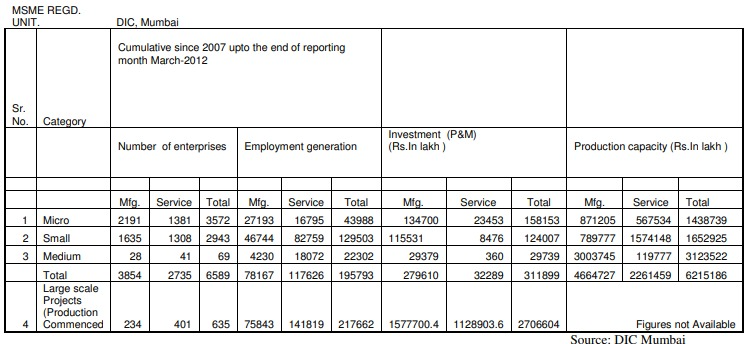
Key Industries
- Textiles & Garments: Once known as the “Manchester of India,” Mumbai remains a significant player in the textile sector, with industrial clusters in Lower Parel, Dadar, and Sion.
- Pharmaceuticals & Healthcare: Major pharma companies such as Cipla, Sun Pharma, and Lupin operate here, contributing to both domestic supply and exports.
- Information Technology (IT): Mumbai’s Bandra-Kurla Complex (BKC) and Andheri are home to IT and fintech companies, fueling digital innovation.
- Petrochemicals & Chemicals: The Chembur Industrial Area houses refineries like BPCL and HPCL, supporting petrochemical industries.
- Engineering & Auto Components: The Saki Naka and Marol industrial estates specialize in engineering goods and auto component manufacturing.
3.2 Details of Existing Micro & Small Enterprises and Artisan Units in the District
| NIC CODE | TYPE OF INDUSTRY | NUMBER OF UNITS | INVESTMENT(LAKH RS.) | EMPLOYMENT |
|---|---|---|---|---|
| 20 | Agro based | 95 | 2939 | 2025 |
| 22 | Soda Water | 0 | 0 | 0 |
| 23 | Cotton textile | 250 | 8688 | 6435 |
| 24 | Woolen, silk & artificial tread based clothes. | 250 | 8688 | 6435 |
| 26 | Ready-made garment & embroidery. | 250 | 8688 | 6435 |
| 25 | Jute & jute based | 0 | 0 | 0 |
| 27 | Wood/wooden based furniture | 13 | 313 | 176 |
| 28 | Paper & Paper products. | 69 | 2196 | 832 |
| 29 | Leather based | 72 | 1531 | 1659 |
| 31 | Chemical/Chemical based. | 0 | 0 | 0 |
| 30 | Rubber, Plastic & petro based | 562 | 138977 | 7019 |
| 32 | Mineral based | 0 | 0 | 0 |
| 33 | Metal based (Steel Fab.) | 684 | 55800 | 8168 |
| 35 | Engineering units | 250 | 1971 | 2779 |
| 36 | Electrical machinery and transport equipment | 549 | 20107 | 7164 |
| 97 | Repairing & servicing | 68 | 1449 | 691 |
| 1 | Others | 3977 | 77928 | 158845 |
| TOTAL | 6589 | 311899 | 195793 |
3.3 Major Exportable Items
Mumbai’s industrial clusters play a crucial role in driving exports. The city’s major exportable items include:
Engineering products, Chemical products. Nylon Synthetic Readymade Garments, Embroidered Fabrics, Textiles, Cotton & Art, Silk, Food Products, Pharmaceutical Product.
3.4 Service Enterprises
Potentials areas for service industry
Mumbai City, Borivali, Bandra, Dahisar, Goregaon, Kandivali, Malad, Andheri, Marol
Sources: (1). Last updated: 01/03/2025. Missing or inaccurate data? Report